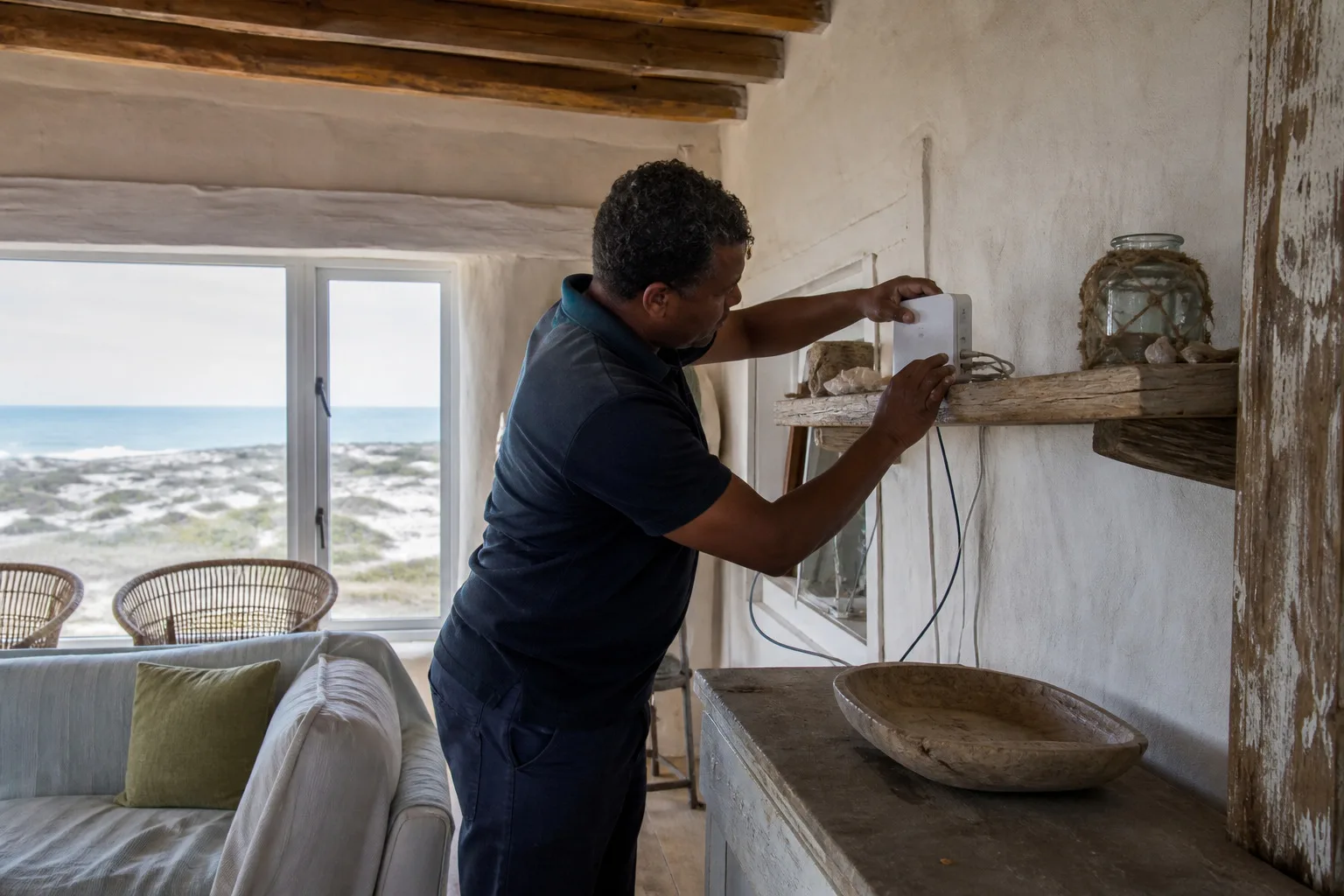
Beach houses are wonderful, but they're often terrible for WiFi. Thick double-brick walls, long passages, additions built on over the years, a flatlet at the back and a stoep everyone wants to sit on: it all adds up to a home where a single router in the lounge simply can't reach. You end up with a strong signal in one room and a frustrating dead zone everywhere else. The good news: dead-spots are completely fixable, and you don't need to live with the buffering wheel.
Why one router isn't enough
A WiFi router broadcasts a signal that fades quickly through walls and over distance. In a compact modern apartment, one good router covers everything. In a sprawling, solidly built coastal house, the same router runs out of puff halfway down the passage. Moving it helps a little, but you're really just shifting the dead-spot from one end of the house to the other. The fix isn't a stronger single router: it's spreading coverage across the whole home.
Mesh systems: the modern fix
A mesh WiFi system uses several units placed around the house that work together as one seamless network. You keep the same network name everywhere, and your phone or laptop simply hands over to the nearest unit as you move: from the lounge to the bedroom to the stoep: without dropping. For most beach houses, a well-planned mesh is the cleanest answer, and getting the placement right is most of the skill. That's the heart of what our WiFi, fibre and network cabling service does: survey the house, find the dead-spots, and put coverage exactly where it's been missing.
Access points and cabling: the rock-solid option
For larger homes, guesthouses or anywhere with a separate flatlet or outbuilding, wired access points are the gold standard. We run a network cable to each point so it gets a full-strength feed, then the access point broadcasts strong WiFi locally. It's more involved than dropping in a mesh node, but the result is bulletproof coverage that doesn't degrade: ideal if you rent the place out and can't afford guest complaints.
Common dead-spot culprits in coastal homes
- Double-brick or stone walls that swallow the signal
- Long, narrow passages with the router stuck at one end
- Additions and flatlets built on after the original wiring
- A router hidden inside a cupboard or behind the TV
- Thick-walled stoeps and patios just out of reach
It's not always the WiFi: sometimes it's the line
Before throwing hardware at the problem, it's worth checking the incoming connection itself. A slow or unstable fibre or LTE line will feel like a WiFi problem even when the WiFi is fine. We set up and configure routers for fibre and LTE as part of the same visit, so you're not left guessing whether the issue is coverage or the line coming in.
How much speed do you actually need?
People often assume a dead-spot means they need a faster internet package, but the two are separate problems. Speed is about the line coming into the house; coverage is about getting that line to every room. A blazing-fast fibre connection still feels useless in a bedroom the WiFi can't reach, and a modest line spread well can keep a whole family happy. For most holiday homes, the honest answer is that you need less speed than the marketing suggests: enough for a few streams of video and the usual phone traffic is plenty. What you really need is for that connection to actually arrive in the rooms you sit in. So before upgrading to a pricier package, it's worth checking whether the problem is the line or the layout. We test both as part of a survey, and more often than not the fix is better-placed coverage, not a bigger bill. If the line genuinely is the bottleneck, we'll tell you straight and set up a fibre or LTE router to make the most of what's available.
Getting the holiday house ready
If this is a home you only use seasonally, sorting the WiFi is one of the jobs best done before everyone arrives: alongside the satellite and the cameras. We cover the full pre-season run-through in our guide to setting up the holiday house for the season, so the first night of the holiday isn't spent resetting a router in the dark.
Let's get every room connected
As local DStv and WiFi installers in Yzerfontein, we know exactly which fixes hold up in these older coastal homes.
We'll survey your house, find the dead-spots, and recommend the simplest fix that actually works: mesh, access points, cabling, or a combination. No overselling, just strong, reliable WiFi in every room, on the stoep and out at the flatlet. Send us a WhatsApp describing where the signal drops, and we'll sort it.