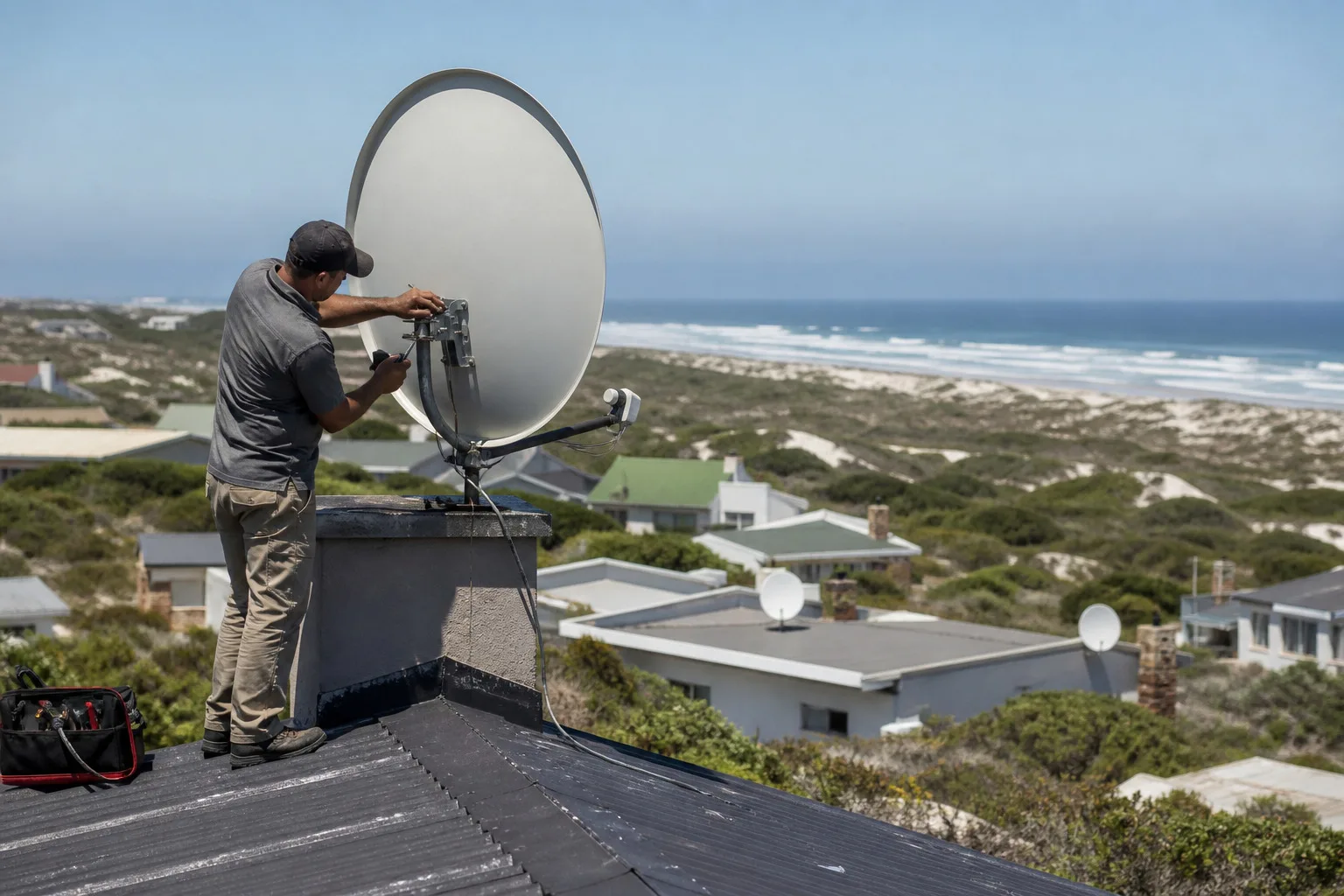
On the West Coast, your satellite dish takes a beating that inland installs never see. Salt-laden air, a relentless Atlantic wind and bright, baking sun all work quietly against a setup that wasn't built for the coast. The good news is that a dish almost never fails without warning: it gives you clear signs long before the picture disappears completely. Spot them early and a quick re-aim is a cheap, painless fix. Ignore them and you'll be phoning for help during the rugby, in a southeaster, with the whole family watching.
Here are the five signs we see most often in and around Yzerfontein, and what each one is really telling you.
1. It pixelates the moment the wind picks up
A dish that has drifted even a degree or two out of alignment can still hold a watchable picture on a calm day. But the first proper southeaster sets the bracket flexing, and suddenly the screen blocks up, freezes or drops to a "no signal" message exactly when the gusts arrive. If your viewing falls apart in step with the weather, alignment is almost always the culprit: the dish simply no longer has enough signal margin to ride out the movement.
2. Channels drop out in light rain
A correctly aimed dish carries plenty of spare signal to push through light rain and cloud. So if a passing shower: not a downpour, just a bit of drizzle: knocks out your channels, you're running far too close to the edge. That margin gets eaten away by a dish that's slightly off, a tired LNB, or water that has crept into a connector. It's a warning that the setup needs attention before winter really sets in.
3. A creeping "signal not found" error
Error codes such as E48-32 that come and go are classic coastal symptoms. They usually point to a loose connector, moisture in the cable, or a bracket that has slowly worked loose in the wind. Caught early it's a five-minute fix. Left alone, that intermittent fault becomes a dead screen: and it always seems to happen at the worst possible time. The salt air out here speeds the whole process up, which is one of the big reasons a coastal dish needs aligning more often than an inland one.
4. One room is worse than the others
If your main lounge TV is fine but the bedroom or the flatlet keeps dropping, the dish alignment may be acceptable but the cabling, splitters or a multiswitch are letting you down. This is common in homes that have had extra rooms added over the years, or where an XtraView setup was cabled in a hurry. It's worth getting the whole distribution checked rather than just the dish: the fix is often a connector or a length of perished cable, not a re-aim at all.
5. The picture has slowly got worse over months
Not every fault is dramatic. Sometimes a dish creeps out of true so gradually that you adjust your expectations without noticing: until a guest asks why the picture keeps stuttering. Brackets rust, fixings loosen, and a dish that was perfect three summers ago can quietly droop. A slow decline is your cue for a proper signal check and a fresh, precise dish alignment.
What re-aligning actually involves
When we come out, we don't nudge the dish by eye and hope. We meter the signal properly, set the azimuth, elevation and LNB skew to the exact satellite position for our part of the coast, and lock everything down on fixings that resist salt and wind. Then we test the signal strength and quality across your channels before we leave, so you can see the margin for yourself.
- A full signal and error-code diagnosis on the dish, cable and decoder
- Meter-accurate re-alignment: never guesswork
- Replacement of corroded LNBs, connectors and any water-damaged cable
- Bracket and pole checks for wind loading
- A signal-quality report so you know exactly where you stand
Can I check anything myself first?
A little, yes: and it can save a call-out if the fault is simple. Start at the decoder: pull up the signal-strength and signal-quality screen in the settings menu. Strength can read high even when the dish is poorly aimed, so it's quality that really tells the story: if it's low or bouncing around, the dish or cabling needs attention. Next, eyeball the dish from the ground (never climb onto a wet or windy roof): look for an obvious tilt, a rusted bracket, or cabling that has come adrift and is swinging in the wind. Give the visible connections a gentle wiggle: if the picture changes, you've found a loose or corroded connector. What you should not do is try to re-aim the dish yourself. Without a meter you'll almost always make it worse, and a dish nudged by hand rarely lands back on the satellite. Use these checks to describe the problem accurately when you call: that alone helps us arrive with the right parts.
When to call us
Every re-alignment and repair here is carried out by our own DStv installers in Yzerfontein, so you get the same accredited, guaranteed standard of work every time.
If you're seeing any of these signs, a quick re-alignment and a connector check will usually set things right for years. If the picture is already gone, that's a job for fast DStv signal repairs rather than a wait-and-see. Either way, send us a WhatsApp with your address and what you're seeing on screen, and we'll give you a realistic time: often the same day. A few photos of the dish and the error message help us arrive with the right parts.